The Earth's climate history is etched into natural archives like ice cores and tree rings, offering scientists a window into past environmental conditions. These geological and biological records serve as time capsules, preserving intricate details about atmospheric composition, temperature fluctuations, and ecological changes over millennia. Unlike written historical records, these natural archives provide continuous, physical evidence that helps researchers reconstruct ancient climates with remarkable precision.
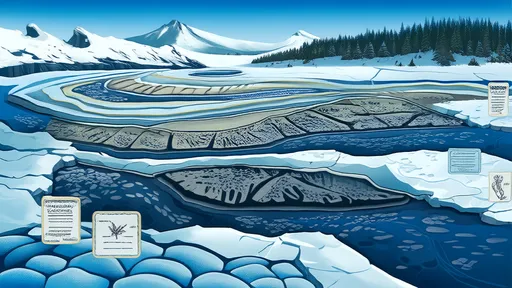
Ice cores extracted from glaciers and polar ice sheets contain some of the most comprehensive climate records available. As snow accumulates year after year, it compresses into ice layers that trap air bubbles, dust particles, and chemical signatures from the atmosphere. The Greenland and Antarctic ice sheets have yielded cores spanning hundreds of thousands of years, revealing patterns of glacial and interglacial periods. Scientists analyze oxygen isotope ratios in the ice to estimate past temperatures, while volcanic ash layers help date specific events. The concentration of greenhouse gases like carbon dioxide and methane preserved in air bubbles provides crucial evidence about historical atmospheric conditions.
What makes ice cores particularly valuable is their ability to capture abrupt climate shifts. The Younger Dryas period, a sudden return to glacial conditions about 12,000 years ago, was first identified through ice core analysis. Similarly, evidence of massive volcanic eruptions that affected global climate for years appears as sulfate spikes in the ice. Recent studies of deep ice cores have pushed our understanding of Earth's climate back to nearly a million years, showing how natural climate cycles operated before human influence became significant.
Tree rings, or dendrochronology, offer another powerful method for climate reconstruction with annual resolution. Each growth ring's width, density, and chemical composition reflect the environmental conditions of that particular year. Wide rings typically indicate favorable growing conditions with adequate moisture, while narrow rings suggest drought or other stress factors. By cross-dating living trees with ancient wood samples, scientists have created continuous chronologies extending back over 13,000 years in some regions.
The study of tree rings has revolutionized our understanding of regional climate variability. Ancient bristlecone pines in North America have provided insights into multi-century drought patterns, while oak chronologies in Europe have helped reconstruct medieval climate conditions. Beyond simple ring width measurements, modern techniques analyze stable isotopes in the wood cellulose, which can reveal details about precipitation sources and atmospheric circulation patterns. Tree-ring data have been particularly valuable for understanding the frequency and severity of extreme events like megadroughts that aren't well represented in the instrumental record.
When combined, ice cores and tree rings create complementary records that cover different timescales and geographic areas. Ice cores excel at preserving global atmospheric conditions over hundreds of thousands of years, while tree rings provide detailed regional climate information with precise annual dating. Together, they help scientists distinguish between natural climate variability and human-caused changes. For instance, the unprecedented rise in greenhouse gas concentrations shown in ice cores correlates with industrial-era tree ring anomalies that reflect rapid warming.
Recent technological advancements have enhanced the value of these natural archives. Laser ablation techniques now allow analysis of individual ice layers at microscopic resolution, revealing seasonal variations in ancient climates. Mass spectrometry methods can detect trace elements and isotopes in tree rings that were previously undetectable. These improvements have led to discoveries about short-term climate oscillations and their ecological impacts that were invisible in earlier studies.
The importance of these climate archives extends beyond academic interest. They provide essential context for current climate change by showing how modern conditions compare to natural variability. Paleoclimate data from ice cores and tree rings feature prominently in IPCC reports, demonstrating that recent warming exceeds the range of natural fluctuations seen in the past two millennia. As climate change accelerates, these natural records become even more crucial for predicting future scenarios and understanding ecosystem responses.
Preserving these environmental archives has become a scientific priority. Glacier retreat threatens ice core records in many mountain regions, while changing growth conditions and deforestation endanger ancient tree populations. International efforts like the International Tree-Ring Data Bank and ice core repositories ensure these invaluable records remain available for future research. As analytical methods continue to improve, scientists expect to extract even more detailed climate information from these natural time capsules in the coming decades.
Looking ahead, researchers are combining these traditional paleoclimate methods with emerging technologies. Machine learning algorithms help identify patterns across massive datasets of tree ring and ice core measurements. New statistical techniques allow better integration of different proxy records to create more comprehensive climate reconstructions. These developments promise to deepen our understanding of Earth's complex climate system and improve predictions about its future behavior.

By /Jun 19, 2025

By /Jun 19, 2025

By /Jun 19, 2025

By /Jun 19, 2025

By /Jun 19, 2025

By /Jun 19, 2025

By /Jun 19, 2025

By /Jun 19, 2025

By /Jun 19, 2025
By /Jun 19, 2025

By /Jun 19, 2025

By /Jun 19, 2025

By /Jun 19, 2025

By /Jun 19, 2025

By /Jun 19, 2025

By /Jun 19, 2025

By /Jun 19, 2025