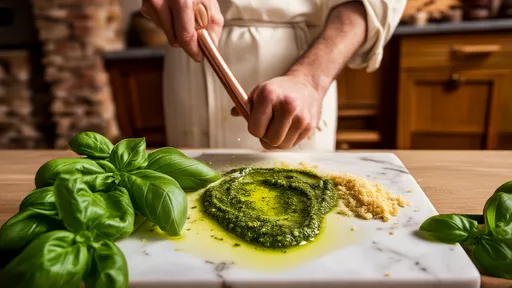
The art of crafting authentic Italian pesto is a delicate dance of flavors, textures, and techniques. At its heart lies the harmonious union of fresh basil leaves, pine nuts, and extra virgin olive oil – a trinity of ingredients that, when combined in the right order, creates a sauce that’s vibrant, aromatic, and deeply satisfying. The sequence in which these elements are introduced to the mortar and pestle isn’t merely a suggestion; it’s a centuries-old tradition that directly impacts the final character of the sauce.
The foundation of any great pesto begins with the basil. Fresh, young leaves are carefully selected, their emerald green color signaling peak flavor. These tender leaves are gently bruised in the mortar, releasing their essential oils without turning bitter. The act of crushing them first allows their aromatic compounds to fully develop before other ingredients join the mix. This step requires patience – a hurried pounding will oxidize the basil, dulling its color and flattening its flavor profile.
Once the basil has reached a coarse paste consistency, the pine nuts make their entrance. These ivory-colored kernels bring more than just their distinctive flavor to the mixture; their natural oils act as an emulsifier, helping to bind the components together. The nuts should be lightly toasted beforehand to enhance their sweetness, then ground just enough to break them down while maintaining some texture. Over-processing at this stage can turn the pesto greasy, as the pine nuts release too much of their oil prematurely.
The olive oil enters the equation last, drizzled in a slow, steady stream as the mixture continues to be worked. This gradual incorporation is crucial – it allows the fat to properly emulsify with the other ingredients, creating a cohesive sauce rather than a separated mess. The oil’s fruity notes should complement rather than overwhelm the other flavors. Quality matters immensely here; a robust, fresh-pressed extra virgin olive oil will elevate the pesto to sublime heights.
Traditionalists argue that this specific order of operations – basil first, then pine nuts, followed by oil – allows each component to shine while creating perfect harmony. The basil’s bright herbaceousness forms the backbone, the pine nuts add depth and creaminess, and the olive oil ties everything together with its lush texture. Deviating from this sequence risks throwing off the delicate balance, potentially resulting in a sauce that’s either too harsh or disappointingly flat.
Modern kitchen technology has introduced shortcuts, with food processors promising pesto in seconds. Yet many chefs maintain that these appliances fail to replicate the nuanced results of the traditional method. The rapid blade action generates heat that can wilt the basil prematurely, while making it nearly impossible to control the texture of the pine nuts. The order of ingredient addition becomes even more critical when using such equipment, as the margin for error shrinks considerably.
Regional variations across Italy offer fascinating insights into how small tweaks in preparation can yield dramatically different results. In Liguria, pesto’s birthplace, the strict adherence to the classic grinding order is considered sacrosanct. Other areas might incorporate slight variations – some toast their pine nuts more aggressively, others might add a splash of oil earlier to prevent oxidation – but the fundamental sequence remains largely unchanged. These subtle differences highlight how a few simple ingredients, combined with care and attention to detail, can create an astonishing range of flavors.
The science behind the traditional method supports what generations of Italian cooks have known instinctively. Basil contains volatile compounds that begin degrading immediately upon bruising. By processing it first and allowing it to meld with the pine nuts’ oils, these fragile aromatics are partially stabilized. The olive oil’s antioxidants then help preserve the bright green color and fresh flavor. This chemical interplay explains why pesto made in the proper order maintains its vibrancy longer than versions where ingredients are haphazardly combined.
Texture plays an equally important role in pesto’s appeal, and the grinding sequence directly affects this aspect. Starting with basil creates a fibrous base that gradually becomes creamier as pine nuts are incorporated. The final addition of oil adjusts the consistency to the perfect coating thickness. Reversing the order would leave the basil insufficiently broken down, resulting in a chunky, uneven sauce that fails to cling properly to pasta.
For home cooks attempting authentic pesto for the first time, resisting the temptation to rush the process is perhaps the greatest challenge. The rhythmic, meditative motion of the pestle against mortar can’t be hurried. Watching the transformation from separate ingredients into a unified sauce is a lesson in patience and precision. When done correctly, following the sacred order of operations, the resulting pesto captures the very essence of summer – bright, herbaceous, and alive with flavor.
Contemporary culinary experimentation has led to countless pesto variations using different herbs, nuts, and oils. Yet even these innovative versions typically follow the original’s basic preparation philosophy. The understanding that certain ingredients must be introduced at specific times to achieve optimal results transcends the classic recipe. This fundamental principle of layering flavors through intentional sequencing remains pesto’s greatest lesson to cooks everywhere.
In an age of instant gratification and shortcut cooking, traditional pesto preparation stands as a testament to the value of time-honored techniques. The deliberate order of operations isn’t culinary pedantry – it’s the accumulated wisdom of generations, refined through centuries of practice. Each step builds upon the last, creating something greater than the sum of its parts. From the first crushing of basil leaves to the final drizzle of oil, every movement has purpose, every ingredient its moment. This is how simple, fresh components are transformed into something magical.
By /Jun 18, 2025

By /Jun 18, 2025
By /Jun 18, 2025
By /Jun 18, 2025
By /Jun 18, 2025
By /Jun 18, 2025
By /Jun 18, 2025
By /Jun 18, 2025
By /Jun 18, 2025
By /Jun 18, 2025
By /Jun 18, 2025
By /Jun 18, 2025
By /Jun 18, 2025

By /Jun 18, 2025
By /Jun 18, 2025

By /Jun 18, 2025